
Last Wednesday, Snapchat released a study on how video consumption behaviours have evolved recently.
I didn’t think the findings were all that surprising but it’s always reassuring to have your opinions backed up with fact. I’ve summarised the key points and my thoughts below:
Optimise Video For Mobile
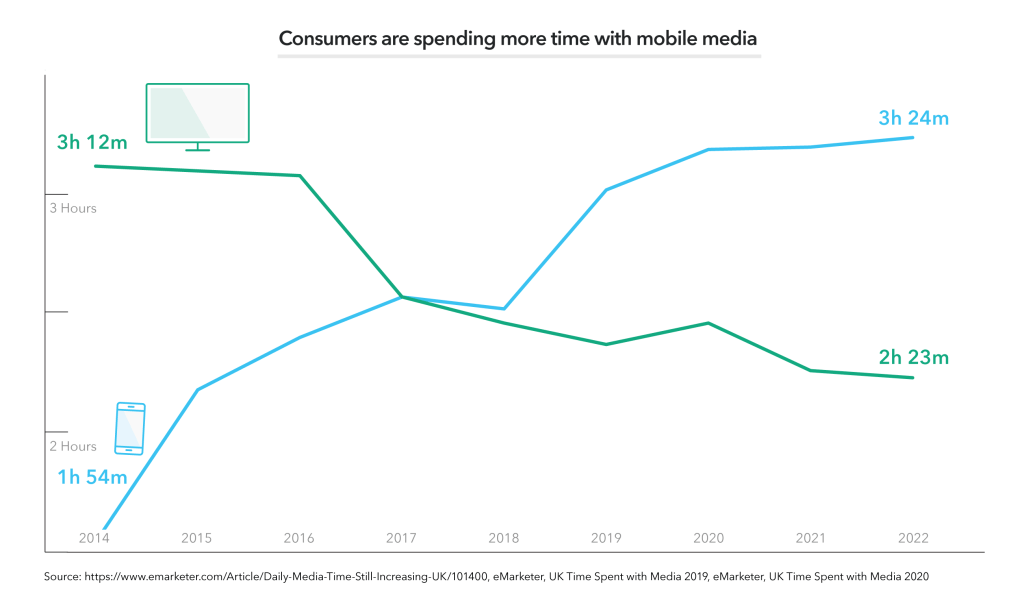
Firstly, mobile phone usage now far exceeds the number of people using their PCs to watch video. In fact, daily video engagement on mobile devices has increased by 25% in 2020 alone.
This figure is typically higher with younger audiences. Whilst consumers tend to watch TV for an average of 2 hours and 23 minutes per day, Gen Z and Millenials are spending around 3 hours and 24 minutes on mobile devices.
Consequently, it’s wise to take this into account when formatting, for example: if you intend to create video content that can be repurposed for other channels, such as IGTV, appropriate aspect ratios should be considered.
Shorter Content is King?
It’s somewhat common sense that shorter video content is more popular than longer pieces as consumers are known to have shorter attention spans when using social media. But the study reveals that more than 8 in 10 consumers prefer short-form content, and that 54% say longer full-length programs or videos are too much of a time commitment for their busy lives (Sounds obnoxious, but that’s what the report said, I promise!).
Personally, I think this may be true for apps such as Snapchat and TikTok, which often feature much shorter videos (it’s worth bearing in mind that this study was conducted by Snapchat). However, considering the popularity of binge-watching Netflix, Youtube, and the fact that Instagram introduced IGTV to allow for longer video content, I don’t believe this to be a universal trend for all platforms.
Personable Content
Unsurprisingly, consumers like personable content that they find relatable and feel drawn to share with others. Apparently, people feel a stronger sense of community when watching short-form video content, likely because it is easier to digest and thus more shareable.
Personally, I think the rise in popularity of TikTok could be partly responsible for this. It has become far too easy to fall into a black hole of watching very short and entertaining videos, which has made longer content feel laborious in comparison. However, that is not to say that longer length videos are not still incredibly popular and valuable when marketing a business – simply that the chosen platform and audience must be greatly considered beforehand.
Overall, the key takeaways are:
- Video content should be optimized for viewing on mobile devices.
- Shorter videos tend to be more popular than longer pieces (depending on a number of variables).
- In order to be popular, videos should be personable, relatable, and shareable.
It’s important to remember that this report is based on data collected by The National Research Group when interviewing Gen Z and Millenials. Therefore, the video consumption habits of older consumers do not necessarily follow these patterns.
Sources: https://forbusiness.snapchat.com/blog/uk-2020-vision-for-mobile-video

 Grace Appleby